The Liverpool Half Marathon starts and finishes in different places, so race-day transport needs more thought than choosing a single meeting point. Runners need to reach the stadium start with time for their preparations, while return collections must account for road closures, baggage collection and the walk out of the finish area.
If you are arranging Liverpool Half Marathon transfers for a running club, friends or a mixed group of runners and supporters, plan the outward and return journeys separately. Request transport in advance, then confirm the actual stopping and meeting arrangements when the organiser publishes the relevant traffic instructions.
Liverpool Half Marathon 2027: confirmed transport essentials
BTR Liverpool has confirmed the next race for Sunday 14 March 2027. Its event page currently lists a 09:30 start at Hill Dickinson Stadium, Regent Road. The organiser’s announcement dated 29 June 2026 confirms that the race will finish at Pier Head, in front of the Three Graces.
| Journey detail | What to plan around |
|---|---|
| Race date | Sunday 14 March 2027 |
| Published start time | 09:30; this is the race start, not a suitable vehicle arrival target |
| Start destination | Hill Dickinson Stadium, Regent Road, with the vehicle drop-off subject to final access instructions |
| Finish destination | Pier Head, with return transport meeting separately at an agreed accessible location |
| Vehicle-access arrangements | Await the confirmed 2027 road-closure and event transport information |
Planning status: the official material reviewed on 16 September 2026 did not establish a dated 2027 road-closure schedule, a confirmed private-hire finish pickup point or an event-specific public-transport timetable for 2027. The linked maps also have no visible event year. Treat their operational details as provisional until BTR reconfirms them.
Runner drop-offs: plan beyond the stadium postcode
A stadium address helps identify the start venue, but it does not tell a driver where they may legally stop on race morning. Closures, stewarded pedestrian routes and restrictions on adjoining roads can all affect the final approach.
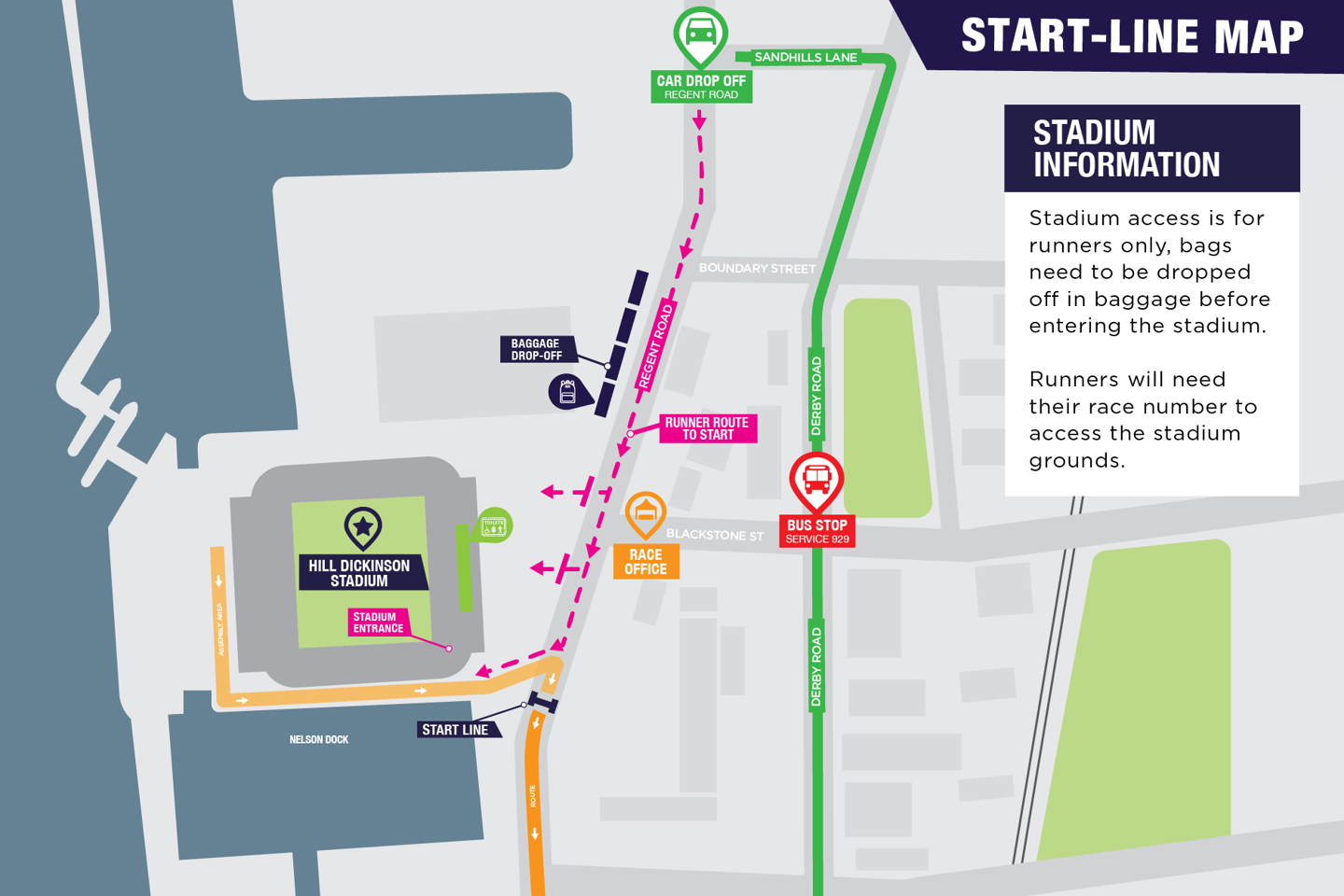
The start-line map currently linked by BTR marks a car drop-off on Regent Road near Sandhills Lane, north of Boundary Street. It shows a separate pedestrian route towards the stadium. This is useful planning information, but the map’s suitability for 2027 still needs confirmation.
Importantly, a marked car drop-off does not establish permission for a minibus or coach to stop or wait there. Your transport operator should check the proposed arrangement for the actual vehicle type, with organiser confirmation where needed.
Work backwards from being ready to run
Do not use 09:30 as your arrival time. Agree an earlier arrival target that allows for the final approach, leaving the vehicle, following the pedestrian route, using event facilities and completing any baggage or start-area procedures.
The right allowance depends on your departure point, the final runner instructions and the access plan. A normal Sunday journey estimate alone is not enough: the last part of the trip may be affected even when the roads further away are clear.
- Keep race numbers, phones and essential running kit within easy reach.
- Have everyone ready before the vehicle reaches the stopping point.
- Agree what happens if the planned approach is unavailable.
- Do not depend on the vehicle waiting while runners prepare or reorganise bags.
Supporter travel needs a separate plan
The currently linked start map says stadium access is for runners only, requires a race number and requires bags to be deposited at baggage before entering. These are published map instructions awaiting 2027 reconfirmation, rather than a complete set of confirmed 2027 admission rules.
Supporters should therefore not assume they can accompany runners into the stadium muster area. Check the final spectator guidance before deciding whether everyone should travel to the start together.
For a mixed group, discuss whether supporters will leave the vehicle at an agreed permitted location, continue elsewhere under a separately agreed itinerary, or travel independently. Do not assume a transfer includes waiting or additional stops: specify what you need when enquiring.
Supporters heading towards the finish should also allow for their own route through the city. Travelling between the stadium area and Pier Head during the race is not simply a repeat of the outward drive, particularly where the course affects access.
Road closures: what previous restrictions tell us
The 2026 event provides a useful illustration of why careful access planning matters, but its closure times are not instructions for 2027.
For Sunday 15 March 2026, BTR announced start- and finish-area closures from 04:00 and course closures from 08:30. The detailed historical schedule included Regent Road between Boundary Street and Walter Street from 04:00 to 12:00, and Canada Boulevard and Brunswick Street from 04:00 to 15:00.
Those restrictions show why neither a direct stadium entrance drop-off nor an immediate waterfront vehicle collection should be assumed. They do not establish where or when your 2027 vehicle can stop.
Check junctions and the whole approach route
The 2026 notice also covered roads crossing or joining listed roads at their junctions. A meeting street that appears outside the race route may still be difficult to reach if its approach crosses a closure.
Once the 2027 information is published, check the complete approach and exit route with the operator, not just the proposed stopping address. A nearby alternative may face the same restrictions as the original point.
Do not turn reopening estimates into pickup promises
The historical closure timings were described as approximate, with roads reopening progressively when safe. The 2026 press announcement and detailed schedule also differed on some reopening times.
For 2027, avoid building the return around an assumption that all waterfront roads will reopen together. Agree a collection arrangement that remains workable under the published restrictions, rather than depending on a barrier being removed at a particular minute.
Finish-area pickups: meet after recovery and baggage collection
The confirmed race finish is at Pier Head, but that does not make the finish line a vehicle pickup point. Plan return transport from an agreed accessible meeting point, subject to the final event traffic plan.
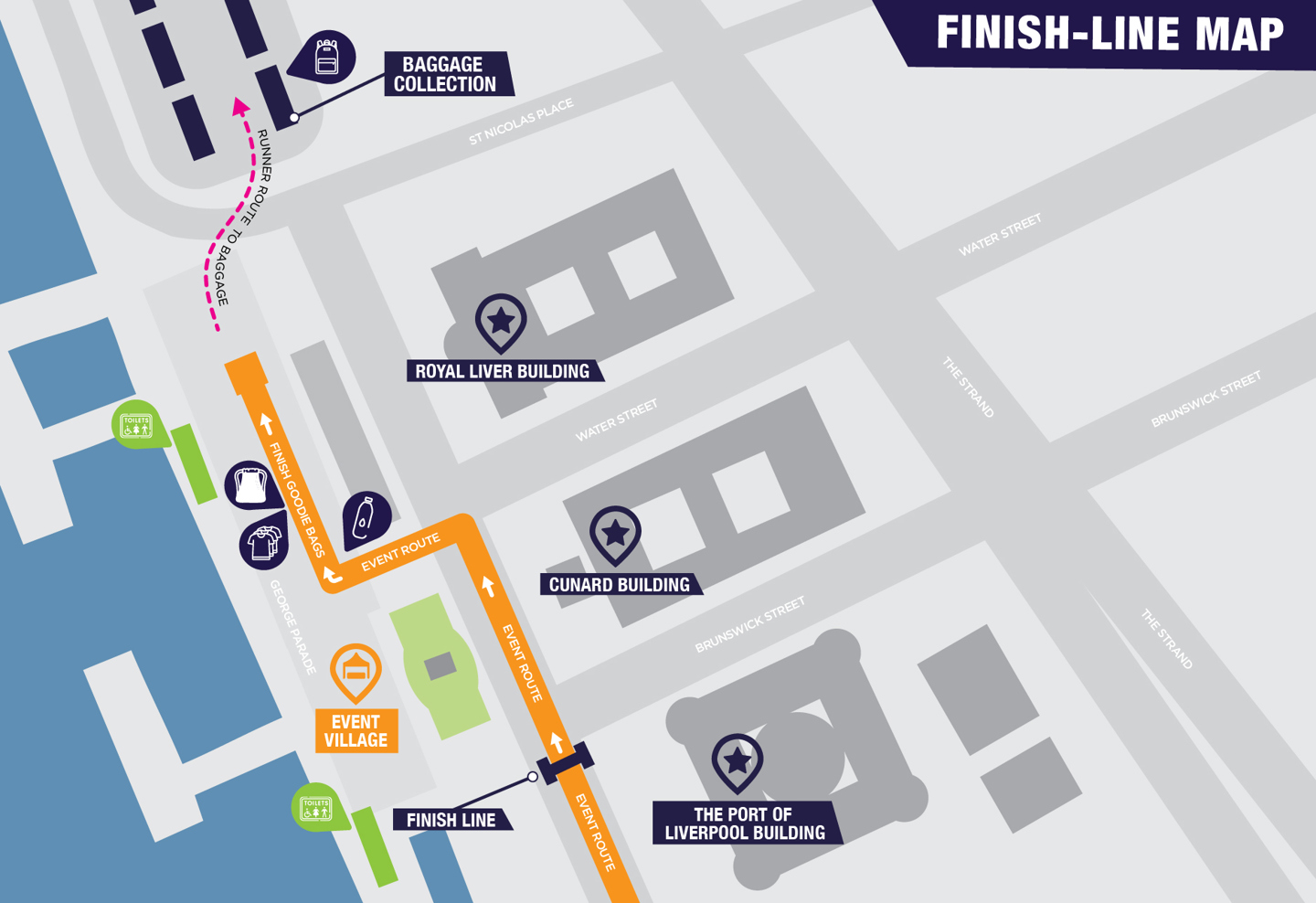
BTR’s currently linked finish map shows a pedestrian route from the finish through the finish amenities towards baggage collection beyond St Nicholas Place. It does not identify a private-hire pickup area, and the map itself is not visibly dated for 2027.
A runner’s expected finish time should be only the starting point for return planning. Allow separately for leaving the finish area, collecting baggage, recovering sufficiently to move on and reaching the vehicle. Do not assume a fixed walking distance before the meeting point is confirmed.
Use a clear group rendezvous procedure
For groups finishing at different times, agree whether everyone will wait for a shared departure or whether separate journeys should be requested. Neither option should be assumed to be included in the original transport arrangement.
- Nominate a lead contact: preferably someone able to monitor their phone while runners are on the course.
- Share the precise meeting point: use an address or map pin and a recognisable landmark, rather than “near the waterfront”.
- Confirm contact arrangements: establish how the lead passenger and operator will communicate on the day.
- Agree a contingency location: check that it has a workable vehicle approach and pedestrian route.
- Explain delay procedures: confirm what to do if a runner is late, withdraws or needs medical attention.
If anyone has limited mobility or expects difficulty walking after the race, raise this before booking. Ask about suitable vehicle access and the proposed pedestrian route; do not assume the closest point is reachable by road.
Choosing transport for runners and supporters
A pre-booked private car or taxi/private-hire transfer may suit an individual runner or a small party. When requesting a quote, describe it as race-day transport with separate start-area and finish-area arrangements, rather than supplying two landmark names without context.
For clubs and larger parties, ask whether an MPV, minibus or another group arrangement is suitable for the passenger count and bags. A vehicle’s passenger seating alone does not establish that it can accommodate everyone’s luggage. Include supporters, overnight bags, changes of clothing and any other equipment in your enquiry.
If you prefer an executive option, ask about availability and suitability. A different vehicle category does not change the road closures or provide permission to enter restricted areas.
When contacting MANPOOL TRANSFERS, provide the following so the proposed journey can be assessed:
- Departure address and any requested additional collection points.
- Total passengers, including how many are runners and supporters.
- Expected baggage and any specific access requirements.
- Your intended arrival target, subject to final race instructions.
- The range of expected finishing times and preferred group departure arrangement.
- A lead contact and the return meeting requirements.
Confirm vehicle suitability, waiting terms, additional stops and how changes will be handled before accepting an arrangement. Requesting transport early is sensible planning advice, not an organiser requirement or a guarantee of particular access.
Could public transport work for part of the day?
Public transport may be worth considering for supporters or passengers travelling separately. For the 2026 race, BTR announced an Arriva shuttle from Liverpool ONE bus station to Great Howard Street and Blackstone Street, alongside earlier Merseyrail services.
Those announcements do not confirm equivalent services for 2027. Check the new event notices and relevant operators’ timetables before relying on a shuttle, an early train or a particular connection. Any split travel plan should still include a clear way for the group to reunite after the race.
Your final race-week transport checklist
Recheck BTR’s current runner information, maps and road-closure notices nearer race day, even if your transport was arranged months earlier. Make sure everyone has the same final instructions.
- Confirm the published start time and required arrival procedures.
- Reconfirm the permitted drop-off for your actual vehicle type.
- Check supporter access rather than assuming stadium entry.
- Confirm the return meeting point and contingency location.
- Allow for finish-area exit, baggage collection and recovery before collection.
- Save the agreed contact details and share them with the group.
The most useful race-day plan keeps three things distinct: where the race starts, where runners finish and where a vehicle can safely and legally collect them. Getting those details agreed gives runners and supporters a clearer plan for both ends of the day.
Book with ManPool Transfers
Ready to arrange your journey? Book Here for a pre-booked ManPool Transfers quote.